In this unit, you are going to learn the correct forms of the passive voice in different tenses.
How to form the passive voice
In general, we add an extra form of “to be“ to the tense and change the verb to its past participle form. Here is an overview:
Simple Present
am/is/are + Past Participle
Examples:
| Active | Passive |
| I play football. | Football is played all over the world. |
| A lot of children read this book. | This book is read by a lot of children. |
| Many people don’t like haggis. | It is known that haggis is not for everyone. |
(If you don't know what haggis is, make sure to watch the video above ;-) )
Present Progressive
am/is/are + being + Past Participle
Examples:
| Active | Passive |
| The chef is cooking the meal. | The meal is being cooked by the chef. |
| Her parents aren’t watching her. | She isn’t being watched by her parents. |
| Somebody is laughing at them. | They are being laughed at. |
Simple Past
was/were + Past Participle
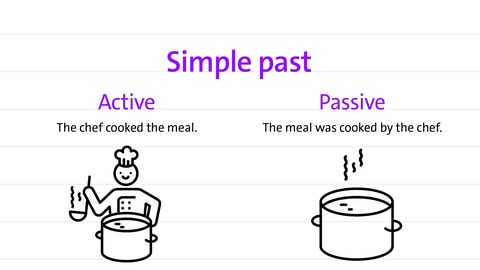
Examples:
| Active | Passive |
| My parents loved me. | I was loved by my parents. |
| The boss fired him. | He was fired by his boss. |
| The team celebrated with the winners. | They were celebrated by their team. |
Past Progressive
was/were + being + Past Participle
| Active | Passive |
| They were cleaning the street all night. | The street was being cleaned all night. |
| She was driving her children to school when the news came. | The children were being driven to school when the news came. |
Present Perfect
has/have been + Past Participle
| Active | Passive |
| They have already eaten the salad, none is left. | The salad has already been eaten, none is left. |
| We have never played rugby at school. | Rugby has never been played at schools in Germany. |
| He has just opened the door and now there is a draft. | The door must have just been opened. There is a draft now. |
| They recently have built a new house. | Their new house has been built recently. |
| They have done a lot of negotiating but have not agreed on contracts so far. | A lot of negotiations have been held but no contracts have been agreed on so far. |
Past Perfect
had been + Past Participle
| Active | Passive |
| At its end the revolution had brought to life a new dynasty. | After the end of the revolution, a new dynasty had been brought to life. |
| They had never played the game before. | This game had never been played before. |
| When I arrived, they had already finished the meal. | When I arrived, the meal had already been finished. |
Will-future
will be + Past Participle
| Active | Passive |
| He will beat him in the final. | He will be beaten in the final. |
| They will nominate her for Nobel Prize. | She will be nominated for Nobel Prize. |
| Harvard University only accepts exceptionally good students. | I’m sure that she will be accepted at Harvard university. |
Going-to-future
am/is/are + going to + be + Past Participle
| Active | Passive |
| Construction workers are going to build our new house next summer. | Our new house is going to be built by construction workers next summer. |
| My father is going to drive us to Glasgow. | We are going to be driven to Glasgow by my father. |
Future Perfect
will have + been + Past Participle
| Active | Passive |
| I will have received my diploma by then. | I will have been given my diploma by then. |
Watch out!
- There are a few special cases of passive voice. One such case is the use of the Present Perfect Progressive and Future Progressive tenses. Usually, the progressive forms in the passive voice are not often used by English speakers, who instead try to find a way to rephrase them.
- There are some verbs that do not need an object and therefore cannot be transformed into passive voice, e.g. “He sleeps“.
Download the table of all passive tenses here:
See full list: