In this unit you will be introduced to different techniques and methods on how to learn new words. You will be shown how you can make use of these methods and find out which ones are most effective for you.
A. Methods on how to learn new words
1. Flashcards
• Write an English word on one side of the card and the German meaning along with a synonym, explanation and/or example sentence on the other side.

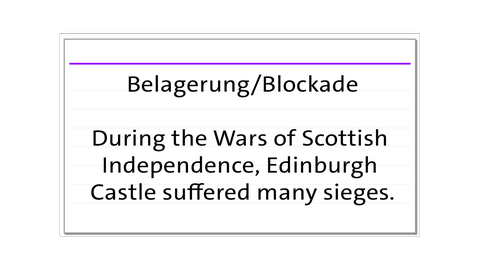
- Repeat regularly and sort the cards accordingly into stacks of known/unknown.
- Use digital tools to create your own interactive flashcards. Look for tools on the Internet.
2. Wordlists
- Write English words in a list and write the German meaning next to each word, as well as adding a synonym, explanation or/and example sentence.
- Create different word lists for certain topics for easier memorizing!
Example wordlist for “Tour of Edinburgh Castle”:
| arsenal | Waffenlager a collection of weapons and military equipment |
| fortification | Befestigungsanlage a defensive wall or other reinforcement built to strengthen a place against attack |
| heritage | Erbschaft/Erbe 1. Property that one might inherit 2. Valued objects and qualities, such as historic buildings and cultural traditions that have been passed down from previous generations |
| regency | Regierungssitz/Regentschaft office or period of government by a regent |
3. Mnemonics
Experiment with mnemonics (= all kinds of memory tricks to associate the meaning of new vocabulary) by using e.g.:
- stories
- songs
- sounds
- drawings
Examples:
- accommodation: I always like to come to a place that has two c’s/cots and two m’s/mattrasses, when I travel or am on holiday with my children.
- to buckle: One, two, buckle my shoe, three, four, close the door ….
- to vex: T-Rex likes to vex
- caterpillar

4. Words in context
Learn new vocabulary in context by
- reading books/stories/articles
- watching videos
- immersing yourself into an English-speaking environment
- applying newly learned words in a sentence, story, text
Example of vocabulary connected to “happiness” in context:
Emily discovered that true happiness wasn’t chasing grand achievements, but appreciating the joys of ordinary life, like a child’s laughter or a cup of tea. After a life of pursuing wealth and success, she realized that she had been looking for the wrong state and that true contentment came from being grateful for the small things and approaching life with an optimistic attitude. That way she found a deep, quiet bliss that was more fulfilling ...
B. Fundamental “do’s” for learning new words
1. Regular repetition is key to successful vocabulary learning!
New words need to be learned by repeating them at least five times over a five-to-seven-day period before they are stored safely in your long-time memory, difficult words might take even longer. Regularly learning and repeating only a few words for only five to ten minutes every day is much more effective than memorizing a lot of words shortly before exams.
2. Find out what type of learner you are!
Some learners might find it helpful to loudly say words or listen to new words. Others will rather use visuals, like pictures, diagrams or colours to support their learning process. There are also learners who learn best when moving around while learning new words or when writing them down on e.g. cards, in lists or mind maps.
3. Apply new words!
Make sure you actively use newly learned words. You can make up sentences or stories, or even better, use them in class or in conversations with (native) speakers.
4. Keep up motivation!
Vocabulary learning can be tedious and is not always fun. But don’t get discouraged! Instead, try to keep up motivation by getting into routines, experimenting with new techniques and internet tools, and monitoring your progress.
Exercises: How to Learn New Vocabulary in English