In the following unit, you will practice using relative clauses to give extra information about nouns in English. This will make your writing and speaking clearer and more natural.
Relative clauses are used to add information about a noun and can be defining or non-defining.
Defining relative clauses give essential information that is crucial to understand the sentence. They are not separated by commas.
For example:
“It was my grandma who made these biscuits.“
Non-defining relative clauses are separated by commas and add extra information, which is not necessary to understand the sentence.
For example:
“They plan to visit their mother, who lives in Vienna.“
Relative clauses can be introduced by different relative pronouns depending on what you are referring to:
| Pronoun | Refers to | Example |
| who | people | My grandma, who is 83 years old, made the biscuits. |
| which | animals, things | The cake, which was delicious, disappeared quickly. |
| that | people, animals, things | My grandma made the biscuits that I love very much. |
| whose | ownership, possession | I met a woman whose dog won a prize. |
| whom | people (in formal English, when the object of the relative clause is a person) | My grandma is the grandparent whom I like the most. |
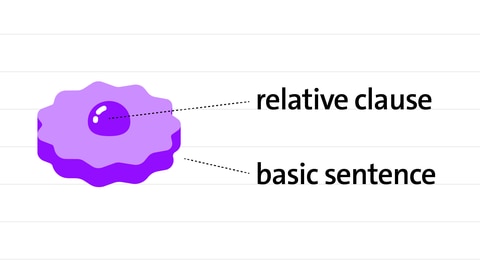
Relative clauses can sometimes be shortened to make sentences more concise.
For example:
“The raspberry jam is the part of the biscuit that tastes the best.“ can be shortened to
“The raspberry jam is the part of the biscuit tasting the best.“
This involves removing the relative pronoun and changing the verb form, while keeping the meaning clear.