In this chapter on emphasis, you will learn how changes in sentence structure can create highlighting effects to point out something. You will learn how the do-emphasis underlines a statement and how inversion flips the sentence to highlight a contrast. After this unit, you will be able to make your language more vivid and more expressive.
In English, emphasis is used to draw attention to important information by altering the sentence structure or by adding certain words. You can use it to express surprise or strong emotions. There are a number of common techniques that can be used to do so, such as the do-emphasis or the inversion, which we will now take a closer look at:
a) Inversion
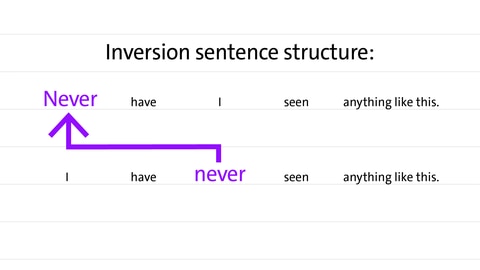
| inversion sentence structure | standard sentence structure |
|---|---|
| adverbial + auxiliary verb + subject + main verb + rest of sentence | subject + verb + object + rest of sentence |
| Never have I seen such an amazing performance in my whole life. | I have never seen such an amazing performance in my whole life. |
| Rarely does she drink alcohol when she is not at a party. | She rarely drinks alcohol when she is not at a party. |
Inversion-adverbials mostly have a negative meaning. Other common inversion adverbials are “rarely”, “hardly”, “little”, or “seldom”.
b) Do-emphasis
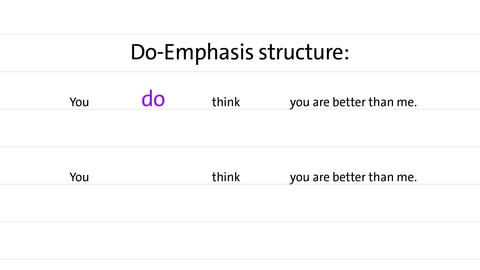
| Do-emphasis structure: | standard sentence structure: |
|---|---|
| subject + do/does + verb infinitive + object + rest of sentence | subject + verb + object + rest of sentence |
| I do like this film! | I like this film. |
| She does work too much! | She works too much. |
As the do-emphasis highlights the verb by adding a ‘do/does’, it is used to put special emphasis on an action and show emotional involvement of the speaker, especially in spoken English.
Exercises: Emphasising and Highlighting Important Information