Phrasal verbs are very common in English. They are combinations of a verb and one or more particles. Together, they create a new meaning.
In this unit you are going to learn how phrasal verbs are formed. A list of common examples will be provided.
Form of Phrasal verbs:
Phrasal verbs consist of a verb followed by a preposition or adverb.
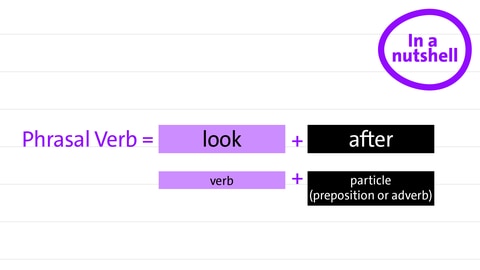
General rule:
The object can either stand between or after the verb and the particle. In a dictionary this is often indicated in the following way: turn something ↔ off e.g. : They turned off the light. / They turned the light off.
But there are two exceptions:
1. If you use a pronoun as the object, that pronoun has to stand between the verb and the particle
⟹ They turned it off. (wrong: They turned off it.)
2. If the phrasal verb consists of a verb and a preposition, the object always stands after the phrasal verb.
⟹ My grandparents look at old photos. (wrong: My grandparents look old photos at.)
Exercises: Phrasal Verbs in Use