This unit will help you to develop your reading skills by showing you different strategies that are useful to understand and work with texts. It will also enable you to cope with reading comprehension tasks in exams.
Basics of reading comprehension
Beside the cognitive benefits that come with reading in general (comprehension/ critical thinking/ analytic skills) reading is essential for language learning as texts are a primary source of material and mean ‘input’ on many levels: vocabulary, grammatical understanding, fluency, proficiency. But only if you comprehend or understand a text fully you will really profit from such an ‘input’.
Reading is a process that can be distinguished in the phases of pre-reading, while-reading, and post-reading:
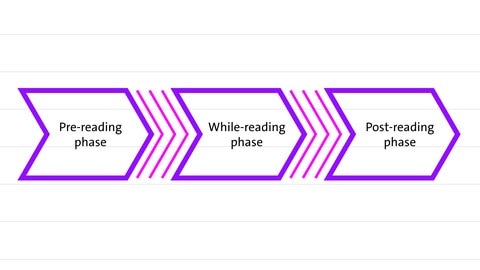
For each stage there are certain strategies which can be applied to improve your reading comprehension skills.
1. Step: pre-reading
Even before reading a text, we most often have an idea what it is about because we predict its contents. To do so we make use of ...
- headlines and subtitles
- pictures
- length
- brainstorming on the topic
Look at this fictional example:
TV series helps save woman’s life
Girl used techniques seen on “Emergency Room”
The headline and subtitle together with one’s knowledge that “Emergency Room” is a hospital series make the reader predict that the article is most likely about a girl who was able to save a woman’s life because she applied techniques learned from watching the series. This knowledge will set the mind in a certain direction and make understanding of the text easier as there is a context to relate to for any new information.
2. Step: while-reading
The while-reading phase is about understanding the main ideas of the text. So, when you read the complete text for the first time it is not necessary to understand every single (new) word, but you should try to get a good comprehension of the contents. Strategies that can help are ...
- Highlighting: Use markers with different colours to highlight different categories of contents like unknown words/ keywords/ main ideas and passages.
- Annotations: Note questions/comments at the margins of the text.
- Chunking: Break difficult or longer texts into smaller sections.
3. Step: post-reading
Post-reading means to go into depth and into the details of the text and preferably even go a step beyond it, so your English skills will benefit. Useful strategies at this stage are ...
- Checking unknown vocabulary: Look up new words and write them on your vocabulary cards or word lists.
- Monitoring comprehension: If something is confusing, re-read it. Make brief one-to-three-word headlines for paragraphs or short summaries. Find key statements in each paragraph.
- Engaging with the text: Further research the topic to answer (exam) questions. Analysing and discussing the text and its information will make future reading easier.
How to deal with reading comprehension in exam situations
Reading comprehension questions are standard in language learning such as in school contexts or in language certificate courses and are designed to test text understanding.
The reading comprehension part in exams presents a text followed by questions to be answered afterwards (post-reading phase). However, in exam situations it is a good idea to read these questions before reading the text. Thus, they can also be used as a pre-reading strategy to predict what the text is about, and you already know what to look out for while reading.
Reading comprehension questions in exams come in different forms, but most common are:
- multiple/single choice questions
- true or false questions
- gapped summary
- multiple matching
- short answer questions
- Mediation Englisch-Deutsch
Let’s have a detailed look at these question types! Read the following text and check, if you know the answers to the sample comprehension questions:
Multiple/Single choice questions
While Multiple Choice questions (MC) present you with more than one correct answer to select, single choice questions have only one correct answer. In exams normally Single Choice questions are standard even if they appear as MCs, so read the task carefully!
Examples:
Multiple choice question
What are the recommended ways to stay safe while practicing winter sports? Mark the correct answers.
| A | Wearing head protection |
| B | Drinking plenty of water |
| C | Avoiding high speeds |
| D | Use different layers of outfits |
Single choice question
Which activity is best suited for someone who wants to explore nature at a more leisurely pace? Mark the most suitable answer by crossing the appropriate letter.
| A | Downhill skiing |
| B | Snowshoeing |
| C | Snowboarding |
| D | Figure skating |
True or false questions
You will need to correctly identify if a statement about the text is true or false. You are often also required to correct incorrect answers.
Example:
Read the statements below and decide if they are true or false:
Gapped summary
In this form of exercise, you will get a summary of (paragraphs of) the text. There will be gaps which have to be filled in with words from the text.
Example:
Fill in the gaps with words from the text. Fill the gaps in the summary with appropriate words or expressions (one word per line) from the corresponding section (paragraph A) of the text. Do not make any changes.
Multiple matching
In matching exercises an item of column A must be matched to an item of column B. Sometimes quotes must be matched to persons, sometimes headlines to paragraphs of the text, sometimes definitions to vocabulary. Occasionally the number of options in column A and B is not identical so that there are one or more wrong options or distractors.
Example:
Match the paragraphs (first to fourth) of the text with the most suitable heading (1-6). Fill in one number per box. There are two more headings than needed.
Headings:
1 Safety advice
2 History of Winter Olympics
3 Moderate winter activities
4 Common features of Olympic disciplines
5 Risks of winter sports
6 Winter sports for all
Short-answer questions
Short answer questions are open questions that ask for your own input and don’t present given options. Instead, you are supposed to answer them in one or two short sentences. You may be asked to use your own words or you may use words from the text.
Examples:
Answer the following questions by providing the required information from the text. You may use words from the text.
Mediation
Bei Mediation müssen Fragen auf Deutsch beantwortet werden. Dabei kann nach der Bedeutung von Vokabeln oder auch nach der stichpunktartigen Wiedergabe von Textinhalten gefragt werden.
Example:
Let’s recap
Pre-reading:
- headlines
- visuals
- brainstorming
While-reading:
- highlight important text passages
- highlight new vocabulary
- note comments and questions
Post-reading:
- check unknown vocabulary
- monitor comprehension
- research topic
Exercises: Tips for Reading Tests