In the following a guideline and word bank for text analysis will be provided. Relevant aspects of text analysis will be practiced by having a closer look at Edgar Allen Poe’s short story “A Tell-Tale Heart”.
Summary Here are ten essentials to keep in mind when reading and analysing a literary text:
Read actively.
Highlight aspects you consider to be relevant and important . Use symbols like ! or ? if there are unknown words, noteworthy repetitions, extraordinary phrases or things that seem to be confusing (at first sight).
Know the context.
Do some research on the author’s life and historical contexts to get an idea why this story was written. But be careful with hasty conclusions!
Look at the structure.
Explore the form of the text (chapters, prose interrupted by poems, diary entries, letters from X to Y, stream-of consciousness, …) and analyse how it may reflect the text’s overall message.
Analyse the characters.
How many (main) characters does the story present? Are there protagonists and antagonists? How are the individual characters related to one another? Is there anything that sparks conflicts among them?
Study the Language.
Pay attention to the overall tone, style/stylistic devices and imagery,… . Also explain why characters communicate in a particular way and whether this allows for conclusions about the social circumstances they live in.
Find the themes.
What are key themes that the text explores? The ones frequently employed in literary text are death, nature, family conflicts, friendship, mental diseases or moments of initiation in coming-of-age stories. Symbols like a white dove for peace, the human eye as the mirror of the soul or colours like red for anger or love may create a certain atmosphere or convey a particular message.
Interpret.
Do not only describe HOW things are in a literary text but provide an explanation WHY something is done in a particular way . For instance, you do not only want to mention THAT a certain character asks questions all the time but also examine WHY he does that. That’s the basis of interpretation.
Use quotes.
Use quotes to back up your point:
Stay critical.
Do not take everything you read at face value: A narrator, for instance, may be unreliable and could intentionally provide misleading information to the reader. Moreover, try to keep a critical distance to the text and do not copy the style of a short story or novel in your own text analysis.
Reflect and Revise.
Wrong: “The author use much stylistic devices.” => Mistakes often happen in the heat of the moment. If you revise the text, you will probably see that you need your third person singular -s and that stylistic devices are countable: Correct: “The author uses many stylistic devices.” Moreover, your language should be precise and differentiated. Hence, you should avoid rather vague terms like “normal”, “nice” or “bad”.
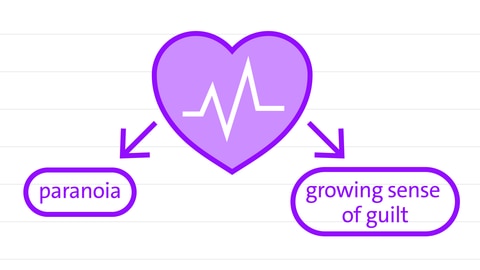
The short story’s title “Tell-Tale Heart” leads already to an important symbol: the beating heart.
BR
This is the typical structure of a text analysis with some helpful phrases and practical advice : 1 Introduction
author: e.g. Edgar Allan Poe title: e.g. “The Tell-Tale Heart” year of publication: e.g. 1843 text type / genre: e.g. short story topic / central storyline
If your analysis is supposed to focus on a certain aspect you should include a thesis statement that mentions your focus:
“I contend that… / This analysis seeks to show / prove / criticize / question… A closer examination of … will demonstrate that …”
2 Main part
Structure
“The story is divided into … chapters / episodes / passages …
Characters
Use the S.T.E.A.L method to analyse characters and focus on:
S peech T houghts E ffect on others A ctions L ooks “The most relevant character trait of X is …
Language and Style
Some commonly used stylistic devices:
metaphor (e.g. "a heart of stone") simile (e.g. “as busy as a bee”) anaphora (e.g. “It was the best of times, it was the worst of times, it was the age of wisdom, …” (Charles Dickens’ novel “A Tale of Two Cities”)) parallelism (e.g. “…and that government of the people, by the people, for the people, shall not perish from the earth.” (Abraham Lincoln, “Gettysburg Address”)) personification (e.g. “The storm clouds angrily gathered overhead.”) irony and sarcasm (e.g. “A police station is robbed.”) ellipsis / incomplete sentences (e.g. “I enjoy reading ... but not writing.") excessive use of questions or exclamations (e.g. "OMG I can't believe it!!!!") “The author employs… in order to…
Themes, Symbols and Motifs
“The symbol… stands for…
3 Conclusion
Exercises: Tips for Text Analysis