In this unit, you will learn everything you need to know about the Past Perfect Progressive. You will learn when to use it, how to form it, and how to ask questions with it.
The Use of the Past Perfect Progressive
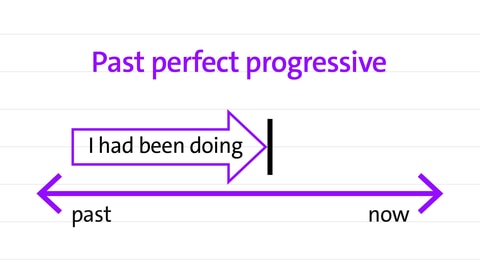
The Past Perfect Progressive is a useful tool for talking about actions that started before a specific time in the past and were still ongoing up to that time in the past.
Let’s have a look at when to use it:
- longer actions that took place before another past event:
We always use the Past Perfect Progressive to express an activity that happened before another event in the past.
⟹ I had been walking for a while before I reached the dentist.
⟹ It had been snowing all day, and the city was then covered in snow.
- actions that began in the past and lasted for a while:
To express how long an activity lasted in the past, we use the Past Perfect Progressive.
⟹ I had been running for hours (before I came home).
⟹ He had been taking a shower for 45 minutes (when his hot water tank finally ran out).
- habits of the past:
It sometimes can also be used to talk about old habits or repeated actions of the past that are no longer relevant.
⟹ They had been going to the chess club every week.
⟹ We had been dividing our chores unequally, but have now found a better solution.
Form and spelling
The Past Perfect Progressive is formed by using the construction had been and the -ing form of a verb.
If you want to ask questions with the Past Perfect Progressive, you will have to invert the sentence structure:
Signal words and irregularities
Signal words that tell you to use the Past Perfect Progressive are: all day, for, since, the whole day/week/month/year, …
Exercises: Past Perfect Progressive