In this chapter, you will learn all about the Simple Present: how and when to use it, how it is formed and how to ask proper questions. It is the most important tense of the English language as it is commonly used for general truths, facts, habits, stories, and much more.
The Simple Present
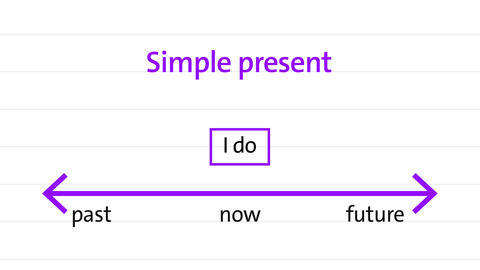
The Simple Present can be used for a number of different contexts or situations:
- repeated actions or habits:
When talking about regular actions or habits you should always use the Simple Present. Signal words to watch out for are frequency adverbs, such as sometimes, often or usually.
⟹ I often forget my keys at home.
⟹ She always needs hours to get ready.
- facts or statements:
You should use the Simple Present to talk about facts or general statements that one would normally think to be true or permanent.
⟹ He loves football.
⟹ I am scared of heights.
- schedules and timetables:
For plans and schedules that are in the future you can also use the Simple Present instead of the will-future. The meaning does not change.
⟹ My lunch starts at 11.30.
⟹ I have an appointment with the doctor.
- instructions and directions:
Often, the Simple Present is used for instructions or directions, for example in recipes or navigation.
⟹ Begin by preheating the oven.
⟹ Leave the highway at the next exit.
Form and spelling
To actually apply the Simple Present in these contexts, use the base form of a verb. Don’t forget to add an -s when you form the third person singular!
If you want to ask questions with the Simple Present, you will have to use do/does with question words like who, where, or what:
Signal words and irregularities
Signal words that tell you to use the Simple Present are: usually, always, never, often, sometimes, every day, in the mornings, on Mondays, …
Irregularities that you have to watch out for are:
- auxiliary verbs: no -s in 3ʳᵈ person singular (exceptions: have ⟹ he/she/it has, be ⟹ he/she/it is)
- irregular endings, e.g.: washes, goes, cries, stays
- irregular forms that end in s or z, e.g.: quizzes