In the following, you will learn in which contexts the gerund form is needed and when to use the infinitive form. This will help you to recognise gerund and infinitive constructions and make correct use of them in your spoken and written English.
Definition
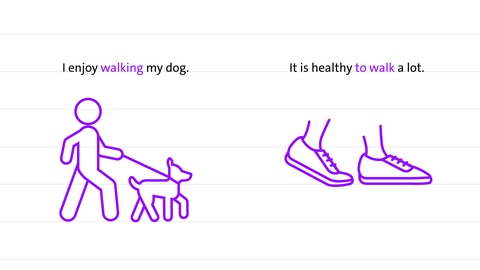
Gerund and infinitive constructions might both look like verbs but actually never act as the verb of a sentence. They can act as a noun and function as the subject or object of a sentence or are constructions following verbs, adjectives or preposition. While gerunds often describe actions or activities that are real, completed or regular, infinitives generally express unreal, planned or future actions, activities or goals.
The gerund is formed by verb + -ing.
The infinitive is formed by to + verb.
Use of gerund
A gerund (= verb + -ing) is used
1 As subject or object of a sentence
Gerund as subject: Gardening is relaxing. Making sandwiches takes time.
Gerund as object: I like jogging. He avoids overtaking in snowy conditions.
2 After certain verbs
The gerund follows these verbs (often expressing actions that are part of regular habits or ongoing experiences):
admit - avoid - consider - delay - deny - dislike - enjoy - fancy - finish - imagine - keep - mind - miss - practice - postpone - risk - suggest
I enjoy drinking tea.
She avoids eating sugar.
They suggested trying something new.
3 After prepositions
If a preposition is followed by a verb it comes in the gerund form, no matter if adjective plus preposition, verb plus preposition or noun plus preposition.
| preposition | gerund | ||
| Are you interested | in | coming | over for tea? |
| I’m good | at | baking | scones. |
| He is fed | up | making | sandwiches. |
| This knife is | for | cutting | bread. |
| What are the odds | of | winning | the lottery? |
| We talked | about | going | to the cafe. |
| I look forward | to (!) | having | tea with Elli. |
Tricky (!): If “to” is used as a preposition after a verb (= phrasal verb) it is always followed by the gerund = verb + -ing and not the infinitive form.
Common phrasal verbs with the preposition to are:
to be used to - to look forward to - get round to - to take to
Examples: He looks forward to having tea with Elli. I have taken to running.
4 After certain fixed expressions
like “be worth”, “no use” and “what about” we use a gerund.
Do you think this car is worth repairing?
It’s no use waiting for the train.
How about visiting Elli?
Use of infinitive
An infinitive (= to + verb) is used
1 After certain verbs
The infinitive follows these verbs (often related to decisions, desires or plans): agree - arrange - decide - deserve - fail - hope - learn - mean - offer - pretend - promise - refuse - seem - plan - wait
Alex wanted to make sandwiches for Elli.
He planned to invite her for tea.
He hopes to impress Elli.
2 After adjectives
If an adjective is followed by a verb it comes in the infinitive form.
It’s important to arrive on time.
It’s hard to choose.
He’s happy to meet Elli.
3 After certain fixed expressions
like “can’t afford”,” can’t wait”, “in order”, “it’s time” and “to be too tired” we use the infinitive:
We can’t afford to ignore climate change any longer.
In order to battle global warming, it needs combined forces.
It’s time to invest more into renewables.
I am too tired to hear the same excuses again and again.
Special uses of gerund and infinitive
1 After these verbs both forms - gerund or infinitive - can be used with little or no difference of meaning:
begin - continue - hate - intend - like - love - prefer - start
Alex likes to make sandwiches for Elli.
Alex likes making sandwiches for Elli.
Tricky(!): After would + like/love/hate/prefer … only the infinitive can be used.
Would you like to meet me for a meal?
She would prefer to come later.
2 With these verbs both forms – gerund or infinitive – can be used, but there is a difference of meaning:
remember/forget
| gerund | infinitive |
| “I remember posting the letter.” Deutsch: “Ich erinnere mich, dass ich den Brief eingeworfen habe.” | “I remembered to post the letter.” Deutsch: “Ich habe daran gedacht, den Brief einzuwerfen.” |
| “I’ll never forget flying over the Himalya. I will always keep that picture in my mind.” Deutsch: “Ich werde niemals vergessen/mich immer daran erinnern, wie ich über den Hiamalya geflogen bin.” | “The clothes are still wet, because I forgot to switch on the tumble dryer.” Deutsch: “Die Wäsche ist noch nass, weil ich vergessen habe den Trockner einzuschalten.” |
| Meaning: We use remember/forget doing something when we think about something we did in the past. The remembering happens after the action/activity. | Meaning: I use remember/forget to do something for necessary action/activities. The remembering happens before the action/activity. |
regret
| gerund | infinitive |
| “I regret telling her about it.” Deutsch: “Es tut mir leid, dass ich ihr das erzählt habe”. | “I regret to say that we have to cancel your appointment.” Deutsch: “Ich bedauere Ihnen mitteilen zu müssen, dass wir den Termin absagen müssen.” |
| Meaning: We use regret doing something when we feel sorry for having done something and feel we shouldn’t have done so. | Meaning: We use regret to do something when we feel sorry for having to do/say something but are unable to do otherwise. |
stop
| gerund | infinitive |
| “I stopped drinking coffee.” Deutsch: ”Ich habe aufgehört Kaffee zu trinken.” | “I stopped to drink coffee.” Deutsch: ”Ich habe (mit etwas) angehalten, um Kaffee zu trinken.” |
| Meaning: We use stop doing something when we quit an action. | Meaning: We use stop to do something when we interrupt something to do something else. |
In a nutshell
We use gerunds
- as subject/object of a sentence
- after certain verbs
- after prepositions
- with certain fixed expressions
We use infinitives
- after certain verbs
- after adjectives
- with certain fixed expressions
Exercises: Correct Use of Gerunds and Infinitives in English