There are many different ways to talk about the future in the English language. In this unit, you will learn the most common and correct ways of talking about future events.
The Use of the Future Tenses
There are three key ways of speaking about the future in English: the will-future, the going-to-future, and the future progressive. These will be the tenses covered in this unit but bear in mind that sometimes you can also use present tenses to talk about the future. The present tenses will be covered briefly at the end.
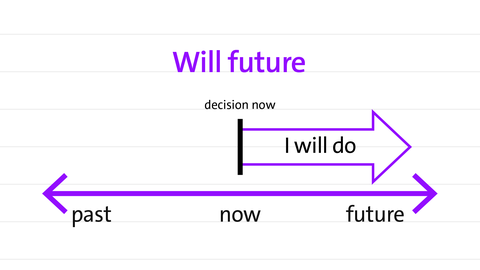
The Will-future
Here is a brief overview of when to use it:
- predictions or expectations about the future:
Use the will-future if something is likely to happen or if a person believes it will.
⟹ It will probably rain tomorrow.
⟹ I think I will win this game.
- spontaneous decisions:
When you suddenly decide to do something or are generally willing to do something, use the will-future.
⟹ I will come to the meeting.
⟹ She’ll join us.
- Promises, hopes and offers:
You use the will-future when offering to do or hoping something or making a promise.
⟹ I promise I will be there.
⟹ I hope, it won’t rain.
⟹ He will help us with it.
Form and spelling
Use the will-future by using will and the infinitive form of a verb.
If you want to ask questions with the will-future, you have to invert the sentence structure. You can also use question words, such as how or what:
Signal words and irregularities
Signal words that tell you to use the will-future are: I think/hope/expect/promise, I am sure, perhaps, probably, certainly, …
The Going-to-future
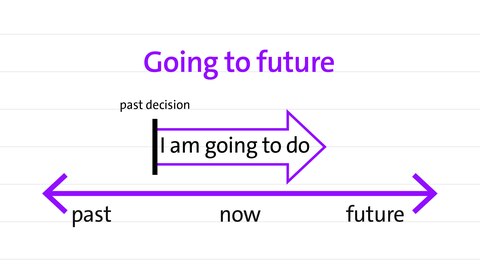
You need to use the going-to-future if something has already been planned or is definitely going to happen in the future. It is always used with decisions and planes made in the past.
Here is a brief overview of when to use it:
- plans or intentions:
Is something planned or intended to happen, use the going-to-future to talk about it.
⟹ I am going to play football tomorrow.
⟹ He is going to watch TV now.
- predictions based on evidence or visible signs:
If something is predictable and there is evidence for it, also use the going-to-future.
⟹ There is a certain smell in the air; it is surely going to rain soon.
⟹ She is going to move to Munich next year.
Form and spelling
The going-to-future is formed by using be + going to + infinitive of verb.
If you want to ask questions with the going-to-future, youʼll have to invert the sentence structure. You can also add question words such as how, what, why, which, when, where or who:
Signal words
Signal words that tell you to use the going-to-future are: tomorrow, next week, surely, …
The Future Progressive
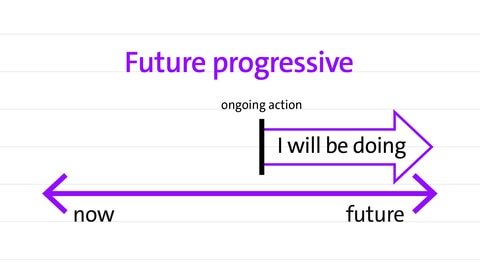
We use the future progressive to speak about actions in progress at a specific time in the future. As with the other progressive forms, the focus is on the process of the action rather than the outcome.
Letʼs have a look at the situations in which it is used:
- ongoing actions at a specific point in the future:
⟹ He’ll be watching TV when I get home.
⟹ I won’t be looking at my mobile all the time at next week’s lecture.
Form and spelling
The future progressive consists of will be followed by the present participle (the -ing form of a verb).
If you want to ask questions with the future progressive, you will have to invert the sentence structure. You can also add question words at the beginning:
Signal words
Signal words that tell you to use the future progressive are: at this time next Sunday, then, …
Simple Present and Present Progressive with future meaning
Present tenses are normally used for future events if the effects of the action are already visible in the present. This is the same concept used in the going-to-future.
These are the contexts in which you can use present tenses for the future:
The Simple Present is sometimes used in future contexts to speak about timetables, schedules, or even instructions.
⟹ The lesson starts at eleven tomorrow. (timetables & schedules)
⟹ Get your coffee at the cafeteria next time. (instructions)
When plans for the future have a fixed time and place, you can use the Present Progressive. The Present Progressive for future is used in a similar way as the Going-to future.
⟹ I am spending next year in Italy.
⟹ She is starting her new job in August.