This unit will introduce you to the Present Perfect tense and explain how to use it. Besides you will learn how to tell the difference to the Simple Past.
The Use of the Present Perfect
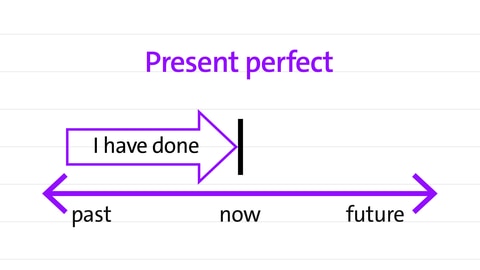
The Present perfect is used to talk about past actions that are related to or continue into the present.
Let’s take a look at when to use it:
- actions that are completed but influence the present:
When something that started in the past is still relevant in the present, we use the Present Perfect. Watch out for signal words that describe an ongoing time, e.g. (n)ever, up to now, or for ages.
⟹ I have lost my passport. I need to apply for a new one.
⟹ - They are not here. They have gone shopping.
- actions that have just been completed:
Has an action just been finished, use the Present Perfect. Signal words to watch out for: just, a few seconds ago, not long ago, …
⟹ I have told you seconds ago!
⟹ He has just opened the door.
- actions that started in the past and continue into the present:
The Present Perfect is also used when an action is going on in the present but began in the past.
⟹ Those two have been together for ages.
⟹ He has lived here all this time.
- actions that happened never, once or multiple times:
When talking about how often an action has occurred up to the present, we use the Present Perfect.
⟹ I have never seen the ocean.
⟹ She has only been there once in her life.
Form and spelling
To form the Present Perfect, we use have/has together with the past participle form of a verb. At the end of this chapter, you can find a list of all the irregular verb forms and their past participle forms.
If you want to ask questions with the Present Perfect, you will have to invert the sentence structure:
Signal words and irregularities
Signal words that tell you to use the Present Perfect are: (not) yet, already, just, so far, recently, since (+Zeitpunkt), (n)ever, always, …
They answer the question “How long“ or “How often“?
See full list: