This unit explains the different kinds of quantifiers in English and shows you how they can be used. The exercises will help you to practice their usage and enable you to apply them adequately.
Quantifiers:
- are words/phrases used before nouns to express quantity or amount
- answer the question “How much or how many of something?”
- depend on the type of noun they refer to (countable/uncountable)
Quantifiers for countable nouns
... with the plural form of the noun:
| a few | I need to buy a few tomatoes, |
| few | but they often have few vegetables in the shop. |
| several | I also need several bars of chocolate, |
| a number of | a number of eggs and |
| many | many apples |
... with the singular form of the noun:
| each | I checked each apple in the basket for bruises. |
| every | Every apple in this shop is fresh. |
Tricky! “each” or “every”?
Each refers to groups of two or more and focuses on the single individual in the group, e.g.:
I checked each orange before I put it in my basket.
Every refers to groups of three or more and views the group as a whole, e.g.:
Every salad in the store is fresh.
Quantifiers for uncountable nouns:
| a little | I also need to get a little milk, |
| little | but they often only have little of it stored. |
| a bit of | I also need a bit of ice cream and |
| much | much or |
| a great deal of | a great deal of sugar. |
Tricky! “many” or “much”?
Many is used with countable nouns. Much is used with uncountable nouns, e.g.:
I bought many bananas and much honey.
Tricky! “few” or “a few”, “little” or “a little”?
A few and a little mean that there is a small, but sufficient amount or that there is enough of something, while few and little indicate that there is not enough of something, e.g.:
- I bought a few tomatoes and a little cheese – enough to make a salad.
- But they had only few eggs and little butter in the shop – so I’m afraid I can’t make a cake.
Quantifiers for both countable (c) and uncountable (u) nouns:
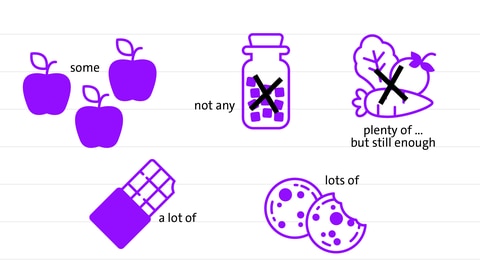
| some | I needed to get some apples (c) but not |
| any | any sugar (u). |
| a lot of | I also took a lot of chocolate (u) and |
| lots of | lots of cookies (c). |
| plenty of | Today they also had plenty of fresh fruit (u) and vegetables (c) |
| enough | in the shop, but we still have enough greens (c) in the fridge. |
| all | So, I could quickly buy all items (c) on my shopping list and |
| no | needed no more food (u). |
Tricky! “some” or “any”?
Some for
- positive statements: I need some butter for the cake.
- polite offers: Would you like some tea?
- requests: Can I have some coffee, please?
Any for
- negative statements: I didn’t buy any sweets.
- questions: Is there any cheese left in the fridge?
Exercises: English Quantifiers