This section will teach you everything you need to know about the Simple Past. You will learn when to use it, how to form it, and how to construct questions with it.
The Use of the Simple Past
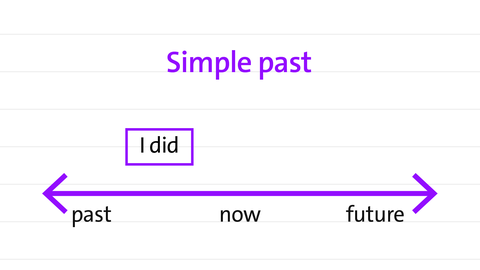
When talking about actions that are already completed, whether they were long or short, repeated or not, we use the Simple Past tense.
Here is a brief overview of when to use it:
- completed single event or action:
Use the Simple Past if something happened once in the past and is no longer ongoing. Look out for signal words that describe the past, such as yesterday or in 2003.
⟹ I adopted my cat in 2021.
⟹ He wore black shoes last week.
- completed repeated event or action:
The Simple Past must be used when the action happened several times, as long as it is completed.
⟹ I walked to class every day.
⟹ She always brushed her hair before school.
- completed events or actions that happened one after another:
⟹ I went to bed and turned off the light.
⟹ He read a lot after he learned to read in first grade.
Form and spelling
Use the Simple Past by adding an -ed to the infinitive form of a verb. But be careful, sometimes the verb has an irregular past tense! At the end of this chapter, you can find a list of all the irregular verb forms.
If you want to ask questions with the Simple Past, you will have to use did:
Signal words and irregularities
Signal words that tell you to use the Simple Past are: yesterday, an hour/month/year ago, last week/month/year, in 2020 , …
They answer the question “When“?
Attention! Irregularities that you should watch out for are: irregular past tenses of verbs, e.g.:
to have ⟹ had
to do ⟹ did
to know ⟹ knew
See full list: