In the following exercise, you will extend your knowledge on different forms of determiners, such as the, two, some or neither. Moreover, you will explore their functions in a sentence by practicing when and how to use the adequate category and form of a determiner in speech.
In detail:
To help you get started, here is a quick overview of all the determiners of the English language and their usage:
Determiners help you to specify, modify, describe, or introduce nouns.
Without a determiner, a statement …
- … can be ambiguous: Mother goes to the shop. => Whose mother? => His mother goes to the shop.
- … can sound unnatural: Shoes don’t fit. => No standard English => These shoes don’t fit.
- … can be overly general: School teachers are lazy. => Some school teachers are lazy.
In a sentence, determiners like “my” or “most” always come first, before other adjectives, modifiers and the noun itself: My big fat Greek wedding.
If you want to refresh your knowledge of sentence structure in English, take a look at our video “Parts of Speech and Word Order”.
| category | determiners | example sentence |
| article | a, an, the | An apple a day keeps the doctor away. |
| demonstrative determiner | this, that, these, those | This statement is clearly a lie. |
| possessive determiner | my, your, his, her, its, our, their | Their daughter finally left home. |
| quantifier | some, any, much, many, few, little, a lot of, several, all, no, both, half | All students were present on exam day, but only half of them were well prepared. |
| numerals | cardinals: one, two, three, ordinals: first, second, third | There were two big wars in Europe in the 20th century. The first one is called the Great War. |
| interrogative determiner | which, what, whose | Whose book is this? |
| distributive determiner | each, every, either, neither | Every rose has its thorn. |
| exclusion determiner | other, another | We need to find another solution to this problem. |
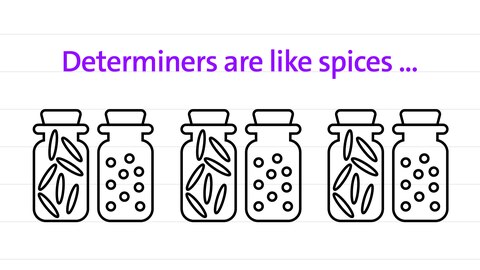
You can think of determiners to be kind of like spices ...
- Articles are like A pinch of salt and pepper; they are basic.
- Demonstrative determiners can be used to point at THOSE/THESE spices.
- Possessive determiners are used to declare ownership over MY spices.
- To measure how much of a spice you need, you can use SEVERAL quantifiers.
- For a specific amount of any spice use numerals like ONE or TWO pinches of salt.
- Want to know WHICH spice to use? Make use of interrogative determiners.
- Distributive determiners refer to a group of spices, like EVERY type of herb.
- Are you out of something? Use an exclusion determiner: Instead of nutmeg you can use OTHER Christmas spices.
In general: There are many different types of determiners, all used for different specifications, modifications, or descriptions.