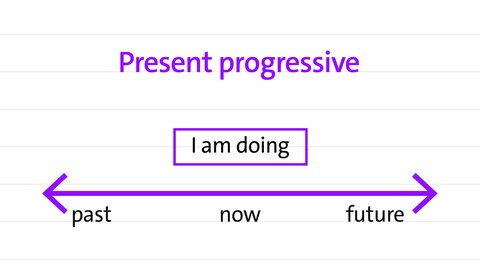
In this unit you get to know the Present Progressive, an English tense that is used to describe actions that are happening at the moment of speaking.
The Use of the Present Progressive
The Present Progressive is one of the English continuous tenses. These tenses always show duration of an action and end with the suffix ʻ-ingʼ. You don’t know what a suffix is? Find out more about them here.
We use the Present Progressive, also called the Present Continuous, in a variety of different situations:
- actions that are happening right now: When talking about events that are taking place at the moment of speaking use the Present Progressive. Watch out for signal words, such as now or currently.
I am currently playing cards.
And sheʼs cheating right now!
- plans for the future: For future plans that have already been arranged you should also use the Present Progressive.
I am leaving Munich in September.
They are watching the game on Saturday.
- actions that are not completed yet: You should use the Present Progressive when talking about temporary states that are not completed yet but are going to end. Words that imply these passing moments could be: at the moment, currently, or while.
I am walking his dog whilst heʼs in the hospital.
He is currently living with his sister.
- trends and changes: You can express gradual change or current trends with the help of the Present Progressive.
I am building my own house.
She is recovering from her illness.
Form and spelling
The Present Progressive is formed from the present tense of “to be” and the present participle, the ʻ-ingʼ form of a verb.
To ask questions with the Present Progressive you have to invert the sentence structure:
Signal words and Irregularities
Signal words that can tell you to use the Present Progressive are: currently, at the moment, now, whilst, while, these days, …
Attention! Irregularities that you have to watch out for are:
- Verbs ending in -e lose it, e.g. facing (to face)
- Verbs ending with a stressed syllable, that ends with a vowel + one consonant, double their consonant, e. g. sitting (to sit)
See full list:
Exercises: Present Progressive