In the following unit, you will learn how modal verbs such as must or may change the meaning of a statement as well as when and how to use those verbs in a sentence.
Summary
Modal verbs are auxiliary verbs that …
- … modify the meaning of a main verb: “You leave the building.” => just a description of what’s going on vs. “You must leave the building.” => obligation
- … do not stand alone and need a main verb: Wrong: “You must the building.” => Correct: “You must leave the building.”
- … do not change form: Wrong: “He musts leave the building.” => no third person singular -s!
- … require substitutes when put into past or future tenses: Wrong: “You musted leave the building.” => Correct: “You had to leave the building.”
- … can be used in a short form in negations: “You must not / mustn’t leave the building.”
- … are put at the beginning of the sentence in questions: “Must I leave the building?”
The analogy of a traffic light can help you become familiar with the differences between modal verbs:
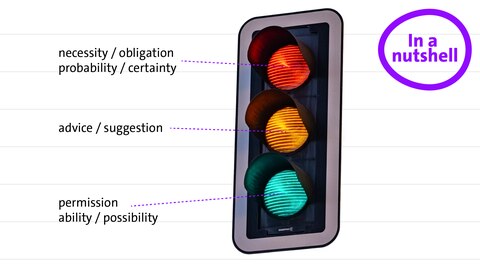
| function | modal verb | example sentence |
| necessity / obligation |
| To take part in a guided tour of the Palace, you must book your ticket in advance. |
| probability / certainty | • must • cannot (one word!) / can’t | If the royal flag is flying on the palace roof, the King must be at home. |
| advice / suggestion | • should / shouldn’t | When you’re at the Palace, you should watch the Changing of the Guard. |
| permission | • may => substitute: be allowed to • can | A princess may wear a precious tiara only after she is married. |
| ability / possibility | • can / cannot / can’t => substitute: be able to • could / couldn’t (past tense of ‘can’ + often used in polite questions) • may • might (past tense of ‘may’ + used when something is less probable) | If you’re at Buckingham Palace, you can take a tour and see some of the 775 rooms. If you’re lucky, you might catch a glimpse of the King. He might even wave back at you. |
Attention: false friends!
You mustn’t enter the room. = You are not allowed to enter the room.
You need not/ don’t have to pay it right now. = There is no obligation for you to pay right now.