In this unit, you’ll practice using connectives to link ideas and sentences in English. They help to show how statements are related to each other and make your writing clear and coherent.
Summary
Connectives are words that join ideas, sentences, or parts of a text. They help to show the relationship between different sentences or parts of sentences.
- Use addition connectives to add more information.
- Use contrast connectives to show opposite ideas.
- Use comparison connectives to show similarity.
- Use cause and effect connectives to explain reasons and results.
- Use emphasis connectives to highlight something important.
- Use example connectives to give examples.
- Use sequence connectives to show order.
- Use conclusion connectives to finish or summarize.
- Use time connectives to express when something happens.
- Use condition connectives to indicate if something happens.
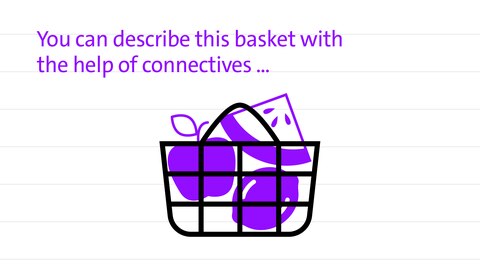
Examples
- In the basket there is not only an apple, but there also is an orange. (addition)
- I love melon. However, I dislike strawberries. (contrast)
- I hate strawberries in the same way as I dislike bananas. (comparison)
- There are no strawberries in this basket, because I don’t like the taste of them. (cause & effect)
- In fact, there’s only an apple, an orange, and a melon in this basket. (emphasis)
- Fruit is perfect for a picnic, as for example, the ones we can see in this basket. (example)
- First, I am going to eat the apple, then the rest of the fruit. (sequence)
- After I am done with this basket full of fruit, I am going to buy another one. (time)
- But as long as I have this one to enjoy, there is no need for more. (condition)
- All in all, you should always eat your fruit! (conclusion)
Common connectives
| Category | Connectives (examples) |
| Addition | also, as well, moreover, in addition, furthermore, not only … but also, besides |
| Contrast | however, although, yet, on the other hand, nevertheless, though, whereas, in contrast |
| Comparison | similarly, in the same way, likewise, just as, equally |
| Cause & effect | because, so, therefore, since, as a result, thus, consequently, hence, due to |
| Emphasis | especially, in fact, above all, in particular, particularly, clearly, notably, indeed |
| Example | for example, for instance, such as, in other words, that is to say, namely |
| Sequence | firstly / secondly / thirdly, then, next, after that, finally, beforehand, eventually, afterwards, meanwhile, subsequently |
| Conclusion | in conclusion, to sum up, therefore, in short, in brief, all in all, to conclude, overall |
| Time | when, while, before, after, until, as soon as |
| Condition | unless, in case, as long as, provided that |
Exercises: Structure Sentences with the Help of Connectives