In this unit, you will learn the difference between sentences and clauses. Furthermore, you will extend your knowledge on clauses by learning about adverbial and noun clauses.
Summary: sentences vs. clauses
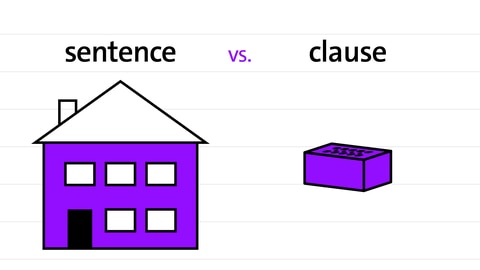
This is a sentence:
I appreciate your support, which still helps me to keep going when times get rough.
The individual parts of this sentence are called clauses:
- I appreciate your support,
- which still helps me keep going
- when times get rough.
A clause is a group of words that includes a subject and a verb, e.g. when times get rough.
Clauses fall into two categories:
In the following part, you will learn how to use adverbial and noun clauses adequately. For relative clauses check out our unit on them. On the exercises page, there is a number of exercises that help you distinguish different categories of clauses and show you how to improve your language skills by forming more complex sentences.
Summary: adverbial clauses
An adverbial clause specifies the verb of a sentence:
He cannot attend the meeting, because he’s ill.
WHY can’t he attend the meeting?
because he’s ill. (= adverb)
Some common categories of adverbial clauses are:
Summary: noun clauses
A noun clause is defined as a group of words that contains a subject and verb, but the entire clause acts as a single noun:
That he let me wait again is simply unbelievable.
- It is simply unbelievable.
I need to check whether I have turned off the oven.
- I need to check that.
I just can‘t understand why he did that.
- I just can’t understand that.