
Tick
|
Lyme borreliosis is found around the world. 40,000 new cases are
reported in Germany alone every year. The borrelia, spiral-shaped
bacteria, can attack various organs: skin, joints, nervous system,
eyes and heart. The borrelia are transmitted almost exclusively
by ticks.
|
 Animated
film Animated
film
|
Since the arachnids can use their "drilling and cutting tools"
to penetrate the skin without pain, many infections are initially
not noticed. The borrelia enter the puncture while the tick is sucking
blood and spread from that point.
|
|
Borreliosis
causes widely differing symptoms. Most of them are so uncharacteristic
that borreliosis can easily be confused with other diseases. The
diagnosis is correspondingly difficult. Fortunately, the pathogen
can be detected in the blood and can normally be treated successfully
with antibiotics. The only existing vaccine is for the borrelia
found in the USA. A vaccine for the borrelia found in Europe is
currently in the development stage.
|

Tick
|
ESME
(early summer meningoencephalitis) is
a virus-caused illness, in contrast to borreliosis. The virus attacks
the central nervous system, possibly leading to permanent paralysis.
A vaccine is available for prevention. Infections with the ESME
virus are comparatively rare.
|
The Immune Defence against Borrelia
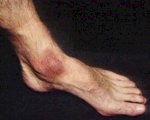
Bullseye (EM)
rash
|
If
borrelia are transmitted by a tick bite, the bacteria begin to multiply
in the area of the bite, then radiate from that point outward in
a circular form. This happens very slowly. It takes two weeks until
there is a noticeable immune reaction. Defence cells march to the
front to fight the borrelia. Starting at the point of the bite,
the skin becomes infected and the typical erythema migrans appears.
It does not cause any discomfort and even disappears after a certain
time.
|
If, however, the
tick hits a blood or lymph vessel, the borrelia quickly move through
the blood and lymph systems to spread throughout the body. The fight
against them then takes place in these systems, not in the skin, and
the EM does not appear.
Normally
the spread of the borrelia through the blood and lymph systems does
not occur until ten weeks after the infection. This period is also
known as the latent phase. Antibodies to fight the borrelia are
formed, and as a consequence of the immune reaction the patient
suffers from fever and pain in the joints and muscles. Typically,
the symptoms disappear again, but relapses occur repeatedly after
long phases often lasting months without any symptoms.
|
 Borrelia
|
Borrelia -
Masters of Disguise
The borrelia are effectively combated by antibodies and the accompanying
defence activities. But the success is not permanent, because borrelia
can spontaneously change their appearance, just like chameleons: the
bacteria put on a shell with new antigens. The previously formed antibodies
are ineffective, and as long as the camouflage goes undiscovered, the
borrelia remain invisible to the immune system. It must first form new
antibodies. Since the borrelia repeat their camouflage manoeuvres at
long intervals, the immune system must repeatedly launch new attacks
to drive away the modified strains of the bacteria. This results in
periodic relapses, accompanied by the symptoms described above, for
the patients.
Borrelia are particularly attracted to connective tissue. Once they
settle in this "hideout," the body's own defence as well as
antibiotics have a difficult time finding them. This can lead to chronic
infections in connective tissues. Early diagnosis and prompt treatment
are therefore very important.
Be
careful with ticks. Anyone who spends a lot of time in
wooded areas or in the garden should always examine his body
carefully for ticks after returning home. If one of these
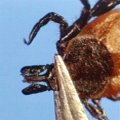
creatures has attached itself, use suitable tweezers to remove
the tick as quickly as possible. The tick can also be examined
to determine if it is carrying any pathogens.
|
 |
|
|