Robert Gallo
|
Two researchers made a name for themselves by discovering the HI
virus: Robert Gallo from the National Cancer Research Center of
the USA and Luc Montagnier from the Pasteur Institute in Paris.
The mysterious "AIDS virus" was finally identified conclusively
there in 1984. At that point in time, 4100 people had already fallen
ill with AIDS in the USA and 2900 of them had died.
|
 Luc Montagnier
|
The "Duel"
of the Virus Hunters
The question as to who had first discovered the HI virus led to
a undignified fight between the two scientists. It involved money as
well as honour and fame. A patented test to prove the presence of the
pathogen in the blood promised lucrative revenues. The dispute was finally
resolved. Montagnier is considered the discoverer and Gallo the co-discoverer.
The revenues from the patents are divided equally between the research
institutes.
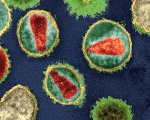
HI viruses |
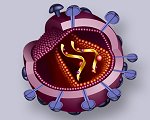
HIV first became visible under the electron microscope. The virus
is only about one ten-thousandth of a millimetre in size and weighs
only one trillionth of a gram. Just as all other viruses, HIV cannot
survive on its own; it needs other cells in order to reproduce.
|
|
HIV is one
of the retroviruses,
i.e., its genetic information is stored in a single strand of
RNA. In human cells, on
the other hand, the genetic information is contained in a double
strand of DNA.
|
|
HI Viruses -
Messengers of Death from the Jungle
Evidence is mounting that the HI viruses are descendants of virus
strains which could originally survive only in animals. There are 18
species of monkeys in Africa known to be infected with a pathogen similar
to HIV - called SIV - but the animals do not die from it. The SI viruses
have managed to cross the barriers between the species at least twice.
They were transmitted from chimpanzees and white-collared Mangabeys
to human beings. The virus strains HIV-I and HIV-II resulted from the
transmission.
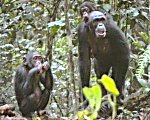
Chimpanzees |
Experts view
the real cause to be the illegal hunting of monkeys and apes for
their meat. When the animals are butchered, blood is spilled and
the risk of injury is great. But even a tiny wound means that someone
can become infected from the blood of an infected animal. So new
virus strains which can survive in the human body are constantly
being created, and some of them can cause serious diseases.
|
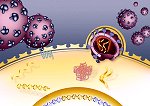
The Life Cycle
of HIV
|