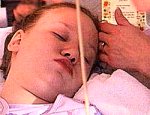
vCJD patient |
Creutzfeld-Jakob
illnesses (CJD, Creutzfeld-Jakob disease) occur rarely, but they
are the most frequent illnesses caused by prions. There is an estimated
one case per million people. Creutzfeld-Jakob illnesses always end
fatally because the nerve cells in the brain die. Along with the
classic form CJD, which has long been known and which is primarily
of genetic nature, a new strain of vCJD has been in the news since
1996. According to current knowledge, vCJD is caused by prions of
animal origin which enter the human body with food. Suspicion falls
most heavily on beef which is contaminated with BSE pathogens.
|
|
BSE = Bovine spongiform
encephalopathy. The deadly animal disease, which causes
the brain to change into a sponge-like consistency, has
made headlines as "mad cow disease." Great Britain
has been most heavily affected, with thousands of cases.
Feeding with animal meal which contains infectious prions
is considered to be the source. Prion illnesses also occur
in other animals such as sheep and goats. Since feeding
with animal meal is no longer permitted, the number of new
cases has fallen substantially.
|
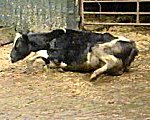
Cow
suffering from BSE
|
|
Great Britain has suffered the most victims
of vCJD. The patients first suffer from depression and anxiety. During
the course of the illness, movement disruptions increase and mental
deterioration progresses. The infection with prions causes pathological
protein deposits to form in the brain. More and more nerve cells are
destroyed until the brain is as full of holes as a sponge. No one knows
how many people already carry the vCJD pathogen. As years can pass between
the time of the infection and the appearance of the first symptoms,
some researchers fear that an enormous wave of illness is coming towards
us.
|
Mysterious
Prions
Prions
consist of a large number of protein molecules and also appear
in the brains of healthy people. The prions probably play a role
in the transmission of information between nerve cells. Pathological
prions differ from normal ones in their spatial structure. They
are folded differently.
|
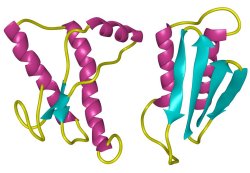
Comparison
of normal and infectious prions (model)
|
|
Infectious prions are not at all comparable
with any previously known pathogens. They contain no genetic material
whatsoever. This contradicts previous medical opinion, which held
that only pathogens which contained genetic material could cause
infections. This is also why the prion hypothesis is still doubted
by some researchers. But the majority of scientists believe that
the incorrectly folded prions can attack the brain.
Unlike viruses or bacteria, infectious prions are resistant to
most disinfectants. Even heating to 100° C cannot do anything
to the pathogens. They are not destroyed until temperatures exceed
130° C. Infectious prions are biologically extremely difficult
to break down.
|
The Forgers at Work
If infectious prions come into contact with benign prions, the
latter assume the pathological form. The result is a chain reaction
producing more and more pathogens, which spread throughout the brain.
As of today, there is no remedy which could stop the forgers.
Lack of Immune Defence
Apparently the infectious prions are similar to the body's own body
prions so that the counterfeits remain undetected. So the immune defence
does not intervene. At any rate, no immune reaction has ever been proven.
The pathogens enter the intestines with the food and spread in the organs
of the lymph system. From here, the prions move along the nerve fibres
and reach the brain without any difficulty. Although artificial antibodies
have been produced against prions in animal experiments, it is still
uncertain as to whether an effective vaccine for humans can be produced
using this method.
Protection from the New Strain of the Creutzfeld-Jakob Disease (vCJD)
|

|
The most effective method
is to remove all infected animals from the food chain. In the
past, this resulted in large-scale mass destruction of animals.
If one animal in a herd tested positive, all of the other animals
were also killed as a precautionary measure. However, the test
procedures are currently not sensitive enough to detect all possible
infections. If consumers want to be certain, they must eliminate
all meat products from their diet which could contain tissue from
the brain, the eye, the small intestine, the spleen, the spine
and hollow bones.
|
|