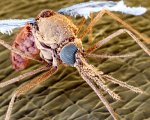
Anopheles mosquito
|
The WHO (World
Health Organization) estimates that between 300 and 500 million
people fall ill from malaria every year. More than one million die
from the consequences of the infection. Malaria is found in many
tropical and subtropical countries.
|
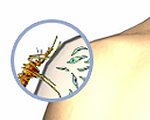
Malaria is caused by one-celled parasites (plasmodia).
They enter the blood system through the bite of a female anopheles
mosquito. We distinguish between four types of malaria pathogens.
The most dangerous is Plasmodium falciparum, which causes malaria
tropica. It is responsible for most of the fatalities from malaria.
The countries in black Africa are most severely affected. The consequences
of an infection include violent attacks of fever, anaemia and serious
damage to organs.
|
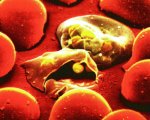 Plasmodia
destroy blood cells
Plasmodia
destroy blood cells |
Malaria in Germany. During the hot summer of the year
1945, there was a malaria epidemic in southwest Germany. The parasites
had been brought in from the tropics by soldiers. Standing water
in the Rhine meadows and bomb craters provided the anopheles mosquito
with excellent breeding opportunities. Some species are also native
to our country. Even today, there are occasionally cases of malaria
in Germany, primarily in the areas around airports. This is why
we speak of airport malaria. The plasmodia arrive with infected
travellers and are then spread by native anopheles mosquitoes.
|
Inadequate Protection by the Immune System
Building
up a certain amount of protection from the pathogen is possible only
for people who live long enough in a malaria area and are regularly
subjected to infections by the parasites native to that particular region.
We call this semi-immunity. Once it has been built up, the body's own
defences can keep the plasmodia more or less under control. While it
is true that the infected people never get completely rid of the parasites
and suffer from recurring relapses, the attacks of malaria are milder.
|
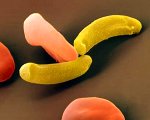
Sickle Cell Anaemia Protects from Malaria. This
hereditary disease occurs more frequently in countries in
which the rate of infection with malaria parasites is especially
high. Sickle cell anaemia is a disease resulting from a genetic
defect which prevents the blood dye haemoglobin
from bonding properly with oxygen and causes the red blood
corpuscles to be broken down more quickly. If physical activity,
for example, causes a lot of oxygen to be withdrawn from the
defective haemoglobin, it clumps together and deforms the
blood cells into a sickle shape. The plasmodia cannot develop
well in the oxygen-poor surroundings and ultimately die along
with the sickle cells. People who have the sickle cell genes
are therefore largely protected from more serious forms of
malaria. But in exchange they suffer all their lives from
a mild form of anaemia. |
|
However, people who come into contact with malaria parasites very
rarely and cannot build up adequate defences are at high risk. That
is why so many of the malaria fatalities in black Africa are children
under the age of five. Travellers are also unable to acquire any immunity
to the plasmodia during their short stays in malaria areas. Since no
effective vaccine has yet been developed for malaria, the only help
comes from medications which kill the parasites. But even this is not
guaranteed in every case as there are some resistant plasmodia strains
which cannot be stopped by anti-malaria medicines.
|
The Life Cycle of Malaria Parasites (Plasmodia)
Malaria pathogens have an extremely unusual life cycle. The
parasite reproduces sexually when in the malaria mosquito, asexually
when in humans. The plasmodia go through a series of development
stages, changing their form in every phase. This is why malaria
parasites are viewed as especially tricky quick-change artists.
|
|
- When a
malaria mosquito bites a human, the plasmodia enter the blood
along with the mosquito's saliva. At this stage, the parasites
are known as sporozoites.
- It takes
only 30-60 minutes for the sporozoites to infect liver cells.
Here a radical transformation takes place. Thousands of merozoites
form from a single sporozoite. After one to two weeks, the liver
cell bursts and washes the merozoites into the blood. However,
sporozoites can survive in a kind of hibernation in the liver
and cause malaria attacks even years later.
- The merozoites
penetrate red blood cells and divide there until the red corpuscles
burst. About twenty merozoites are released and then attack
new blood cells. This growth and reproduction process repeats
itself a number of times, generally every two to three days.
- Part of
the merozoites transform themselves into female or male gametocytes
(precursors of germ cells). If, while enjoying a drink of blood,
a mosquito ingests these gametocytes, it becomes infected. The
parasites now go through a number of sexual development and
reproduction steps. Within a week, sporozoites once again form,
and the anopheles mosquito can infect more people.
|
|
Typical
malaria symptoms during the reproduction phase are fever and
chills. The destruction of the red blood cells (erythrocytes), which
are necessary for the vital transport of oxygen, prevents the organs
from being properly supplied with blood. In extreme cases, the organs
may fail completely.
|
Immune Defence against Malaria
Malaria
parasites with their transformation tricks put the human immune defence
to a severe test. The most effective defence strategy is to stop the
parasites in the stages when they are swimming freely in the bloodstream
(sporozoites, merozoites, gametocytes) with the help of antibodies.
However, the defence must conduct a fight on several fronts, for the
three parasite stages have different shells and also change their surface
structures (antigens) constantly. Many of the antibodies which have
formed remain ineffective because they do not find the right targets
(antigens).
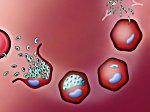
Reproduction of sporozoites |
An effective
immune response is also made more difficult by the fact that the
parasites spend most of the time inside body cells. Sporozoites
reproduce in the liver. When hidden here, they can be fought only
by killer T cells (cytotoxic T cells). But according to our current
state of knowledge, this form of defence against malaria is limited
in its effectiveness.
|
The merozoites are even cleverer. They reproduce in red blood cells.
In contrast to other cells, the red blood cells lack MHC-I molecules
with which they could display fragments of the parasites on their surface.
So the killer cells do not have the "enemy image" they require
and are unable to intervene.
The merozoites have yet another trick up their sleeve to help them
to survive: they induce the infected red blood cells to form certain
surface molecules. These molecules act like "glue" and cause
the blood cells to stick to the vessel walls. This prevents them from
being transported into the spleen, which normally destroys infected
blood cells. The merozoites in the "parking" erythrocytes
are in safety and can reproduce in peace and quiet.
The malaria parasites even understand how to turn defence actions
by the body to their advantage. As a reaction to the pathogen, the phagocytes
release the messenger substance TNF (tumour necrosis factor alpha).
In low concentration, the parasites are killed. But if a certain concentration
is exceeded, the glue effect is reinforced. More and more red blood
cells, even ones which are not infected, stick to the vessel walls and
clump together. This congestion in the blood vessels is further strengthened
by antibodies which attach themselves to the "glue molecules"
of the infected blood cells. Useful to the malaria parasite - they reproduce
best in a low-oxygen environment - this situation can become mortal
danger to the human being: poor oxygen transport and inadequate blood
supply destroy organs such as liver, kidneys or brain.
Protection from Malaria
In spite of substantial efforts, no proven vaccine which protects
from malaria has been developed. This is above all a consequence of
the complicated life cycle of the parasites which use camouflage and
deception to fool the immune defence again and again.
Moreover,
scientists have not yet found a way to cultivate the malaria parasites
on a large scale, which would facilitate production of a vaccine.
As an alternative, synthetically produced antigens could be used.
But it has not yet become clear which surface antigens of the pathogen
lead to an effective defence by the antibodies. One example: the
vaccine SPF 66 developed by Manuel Patarroyo, a cocktail of various
synthetically produced vaccines, proved to be ineffective. Experiments
with other vaccines have also failed to produced the hoped-for breakthrough.
|
 Vaccine experiment
in Africa
Vaccine experiment
in Africa |
We remain dependent on anti-malaria medicine which disrupts the parasites'
metabolism and kills them. However, these important weapons in the fight
against malaria are becoming increasingly dull. Some plasmodia strains
no longer respond to long-proven medications. The pathogens have become
resistant to certain substances.
The simplest protection from malaria infection consists of protecting
yourself from the bite of the anopheles mosquito. Since the female bites
only in the early evening hours and at night, so-called repellents (defensive
substances which are applied to the skin) and mosquito nets impregnated
with insecticides can help. Anyone going to a malaria area as a tourist
should consult a physician before leaving and, as appropriate, take
the recommended anti-malaria medicine according to the doctor's instructions.
|