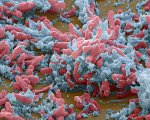
Tuberculosis
pathogens |
Third to AIDS and malaria,
tuberculosis is the most widely spread infectious disease. Every
year, three million people die of this disease, most of them in
East Asia and Africa. But the increase in worldwide travel has also
put the industrialized countries, which are less affected, at a
greater risk from the pathogen. It is also alarming that more and
more germs are appearing which are resistant to the previously reliable
antibiotics. Although it is possible to vaccinate people for tuberculosis,
the effectiveness is limited and there is a risk of serious side
effects.
|
| |
|
Tuberculosis bacteria are
transmitted primarily by airborne droplets (from speaking, sneezing,
coughing). The transmission occurs if there is close, longer-term
contact with people suffering from open tuberculosis (infectious
form of TB). This situation is found most often where people with
open TB live together in close quarters, in families, shelters for
the homeless or prisons. Healthy people with a strong immune system
rarely become ill. The risk is greatest for people who suffer from
poor nutrition and whose immune defences have been weakened. This
is the reason why the majority of the cases of tuberculosis are
in poor countries. However, the richer industrialized countries
are also affected, although to a far lesser extent.
|
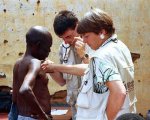
Tuberculosis
treatment in Togo
|
The Immune Defence against Tuberculosis Bacteria
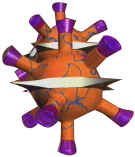 |
Whenever droplets carrying tuberculosis bacteria are breathed
into the lungs, the pathogens allow themselves to be ingested
by phagocytes and hide there like stowaways. This allows them
to escape the immune defence for the moment and they cannot be
reached by antibodies and other weapons. The tuberculosis bacteria
have a trick which enables them to survive in the "stomach"
of the phagocytes, otherwise a deadly environment: they cause
digestive problems, so to speak, for the defence cell gluttons.
The bacteria withdraw into hollow bubbles (vesicles)
of the phagocytes, and the phagocytes are not able to destroy
the vesicles on their own. As a sign of their infection, they
display "wanted" posters of the pathogens on their surfaces.
Special T helper cells (Th1
cells) then hurry to their aid and activate the phagocytes
in order to accelerate their "digestion." Now the stowaways
can be destroyed by aggressive substances. The phagocytes die
in the process.
|
|
|
|
However, part of the bacteria frequently survive and infect other
phagocytes. It is typical of tuberculosis that a number of phagocytes
melt together and form a centre of inflammation which is completely
encapsulated by T cells. A so-called granuloma
forms which can also be seen in X-rays. The granuloma can survive for
years in the human body. During this time, there is a risk of contagion
from the infected person.
The granulomas can break apart again, especially in people whose immune
systems have been weakened, and release tuberculosis bacteria. If they
enter the blood or lymph systems, there is a risk that the pathogens
will spread throughout the body and attack other organs. During this
stage, we speak of open TB, and the infected person can spread the disease
to others.
|
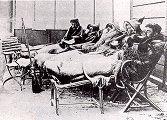
Incurable Tuberculosis. Before antibiotics were
discovered, patients could only hope that their bodies would
fight off the disease on its own. The doctors could do little
more than prescribe rest, fresh air and regular meals. Tuberculosis
remained a feared disease which claimed innumerable lives
until the end of the Second World War.
|
 |
|
Resistant to Antibiotics
As late as the 1970s, physicians believed that tuberculosis had
been defeated in the highly developed industrialized nations. Mass X-ray
examinations were stopped long ago in Germany, and a preventive vaccination
has not been recommended for the general public for years. The number
of cases of tuberculosis in this country is also relatively low. Yet
there are still many countries in which tuberculosis is very common.
The infection rate in the CIS is increasing dramatically.
 |
In
2001, one million people in the CIS were incarcerated. In
many prisons, virtually all of the inmates have been infected
with tuberculosis bacteria.
|
|
The problem: without
knowing it, immigrants can carry tuberculosis pathogens which are very
difficult to treat. Some of the bacteria strains are resistant to a
number of antibiotics.
Resistant germs develop when antibiotics
are not taken regularly and for a sufficiently long period. Since
all of the bacteria are not killed, there are enough left over to
adapt to and break down the substances.
|
|