|
2.1
Pathogens - Attackers from the Microworld
Over the course of evolution, many tiny living creatures (microorganisms)
have succeeded in settling the human body and multiplying there.
The "ecological system human being," consisting of more
than one trillion cells, offers a kind of "room and board."
We live in peaceful co-existence with most microorganisms, but there
are also hostile strains which enter the body and cause infectious
diseases. The pathogens follow the blood and lymphatic vessels and
head for the organs which provide them with the best conditions
for development. Flu viruses (influenza) attack the mucous membranes
of the upper respiratory system, malaria parasites aim for the liver
and red blood cells, while tuberculosis bacteria go for all organs,
but go mostly for the lungs. Infections can cause serious damage
to organs which may even become life-threatening. 25% of all deaths
around the world can be attributed to pathogens.
|
|
The
Struggle "Man against Microbe" Continues
Progress
in medicine such as improved hygiene, modern vaccines and medications
have contributed to taking away the horror of many infectious diseases.
But in the struggle "Man against Microbe," many pathogens
still hold better cards. Some of the reasons for this are shown below:
- There are no
vaccines for many pathogens such as the AIDS virus (HIV) or the malaria
parasites.
- Chemical substances
used to fight microorganisms are losing their effectiveness. For example,
some strains of tuberculosis bacteria have become resistant to certain
antibiotics.
- Once in a while,
new, unknown pathogens appear. Ebola and HI viruses appeared without
any advance warning. The appearance of prions was also a surprise.
These infectious protein substances are blamed for certain pathological
changes in the brain.
- Some pathogens
use tricks to fool the immune system. The most extreme example is
the HI virus, which attacks and destroys vital defence cells.
The
"Wanted" Posters of the Attackers
Pathogens
include viruses, bacteria, protozoa, fungi, worms and prions. The six
basic types differ fundamentally from each other in their form and manner
of reproduction.
|
Viruses
consist of genetic information (DNA
or RNA) enclosed in a protein
shell. They do not have their own metabolism and are therefore
incapable of reproducing without aid. They are therefore dependent
on the help of living cells. Viruses insert their genetic material
into host cells and force them to do nothing but produce copies
of the virus. Infected cells are consequently no longer able to
perform their actual functions or are destroyed by the exertion
of making the virus copies.
Virus diseases include AIDS, Ebola, influenza, hepatitis, polio
and rabies.
|
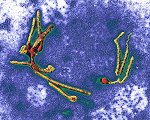
Ebola
virus
|
Bacteria are one-cell organisms. The contents of the cell,
including genetic material and a "production facility"
for proteins, are surrounded by a protective cell wall. In contrast
to viruses, bacteria do have their own metabolism, so they can ingest
and process nutrients. Bacteria also reproduce on their own, primarily
by cell division. Some also have a "drive" which they
can use to move around. Bacteria cause the following diseases as
well as others: borreliosis, syphilis, cholera, salmonellosis and
tetanus.
Some types of bacteria, such as salmonella or tuberculosis bacilli,
also penetrate cells in order to reproduce there. Besides the direct
destruction of tissue, bacteria often produce metabolism by-products
which are toxic to the human organism.
|
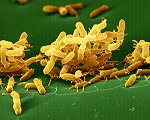
Salmonella
|
|
Protozoa
are one-cell organisms. Unlike bacteria, they have a true cell
nucleus in which the genetic material is surrounded by a membrane.
They also have their own metabolism and reproduce, depending on
the species, by cell division or sexual reproduction. Some protozoa
live as parasites and obtain their nourishment from their host
organism. They cause malaria, leishmaniosis and sleeping sickness
as well as other illnesses. The pathogens reproduce in cells.
|
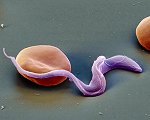
Trypanosom
(with blood cell)
|
|
Fungi belong to the group of multiple-cell organisms. In
contrast to bacteria, they have a cell nucleus and solid cell
walls. Fungi have their own metabolism. They spread and multiply
by producing spores. Pathogenic fungi are frequently found on
the skin and on mucous membranes, but also attack internal organs
such as the lungs.
|
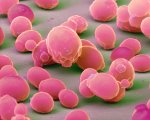 Candida albicans
|
Worms are multiple-cell parasites with their own metabolism.
Humans are infected by the eggs or larvae. In the case of bilharciosis
(schistosomiasis), the pathogens penetrate the skin and attack vessels
and internal organs. Trichinosis is caused by larvae which are ingested
with infected pork.
|
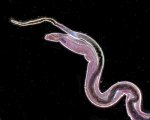
Schistosoma
|
|
Prions are far and away the simplest of all pathogens. They do
not possess either genetic material or metabolism and can therefore
not reproduce independently. Prions consist only of an incorrectly
folded protein molecule which in its healthy form occurs in the
brain of every human being. If an infectious prion comes into
contact with the matching protein molecule in its normal form,
the normal prion assumes the disease-causing form. New, infectious
prions form and gradually destroy the brain.
Prions are regarded as the cause of the new strain of the Creutzfeld-Jakob
disease and the so-called "mad cow disease."
|
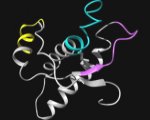 Prions (model)
|
|